How to verify a Swiss company before you sign
A practical checklist for verifying a Swiss counterparty: identity, status, signing authority, publication history, and what the register does not certify.
By Swiss Graph Research10 min read
Topics
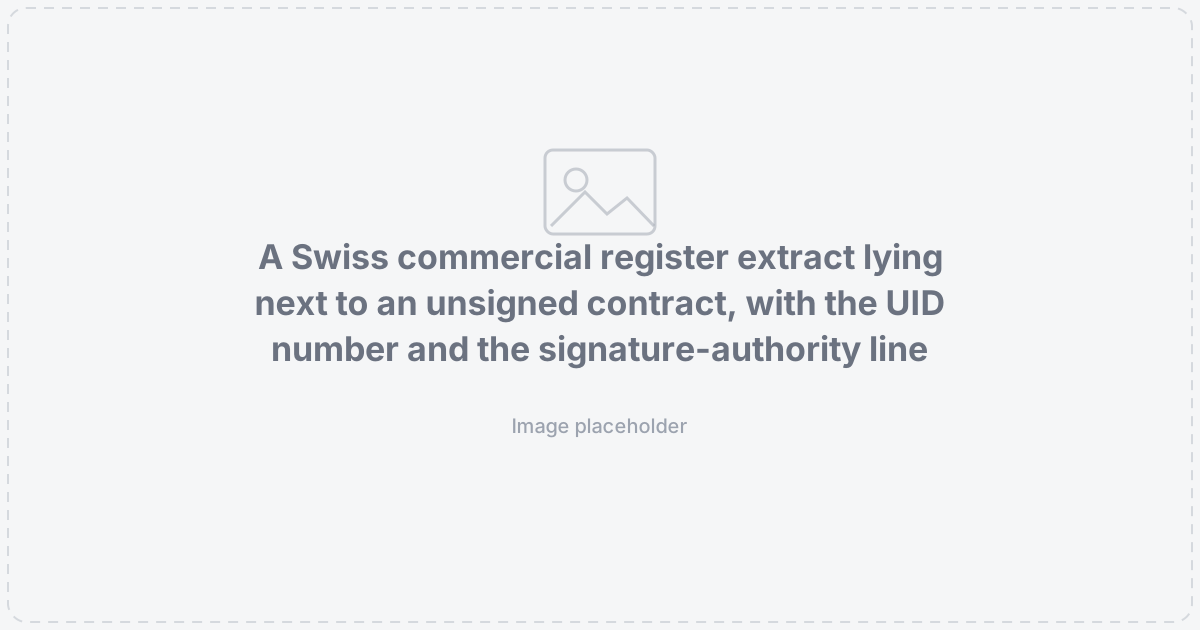
Verifying a Swiss company is four questions asked in order: is this the entity I think it is, does it still exist in this legal form, who is authorised to bind it, and what has changed lately. All four are answerable from the public record without asking the company for anything. None of them tells you whether it pays its invoices — that is separate work, and merging the two is the most common way a check goes wrong.
1. Fix the identity before you check anything else
Start from the identifier, not the name. Swiss legal names collide, get translated, get shortened in correspondence, and change outright — and the trading name on an invoice is frequently not the legal name at all. The stable handle is the UID, the federal business identification number in the form CHE-xxx.xxx.xxx. It survives a rebranding, a change of seat and a conversion of legal form. A name search survives none of those.
Look the entity up in the register, then check four fields against the paperwork in front of you: legal name, legal form, registered seat and UID. The seat is a Swiss political municipality rather than a street address; a company seated in Zug and operating out of Zurich is entirely ordinary.
Two traps sit here. A branch has its own register entry and its own UID but is not a separate legal person: contracting with a branch means contracting with the head office, which may be abroad. And groups routinely hold near-identical names across cantons, so the entity on the letterhead is not necessarily the one you are being asked to pay.
The official federal entry points are Zefix, the central index of Swiss commercial register entries, and the UID register behind the CHE numbers.
2. Confirm the status, and read a deletion properly
The entry tells you whether a company is active, in liquidation, or deleted. Active is where the check starts, not where it ends.
A deletion is not automatically bad news. A company is deleted after a completed liquidation, but also when it is absorbed in a merger, and when it moves its seat to another canton — which appears as a deletion in the old register and a new entry in the new one, for the same business. Read the reason rather than the status word.
"In liquidation" carried in the legal name is a different matter: a material fact about your counterparty that should pause the process until you know why it is there.
3. Check that the person signing can actually sign
This is the step most often skipped, and it is the one the register is best at.
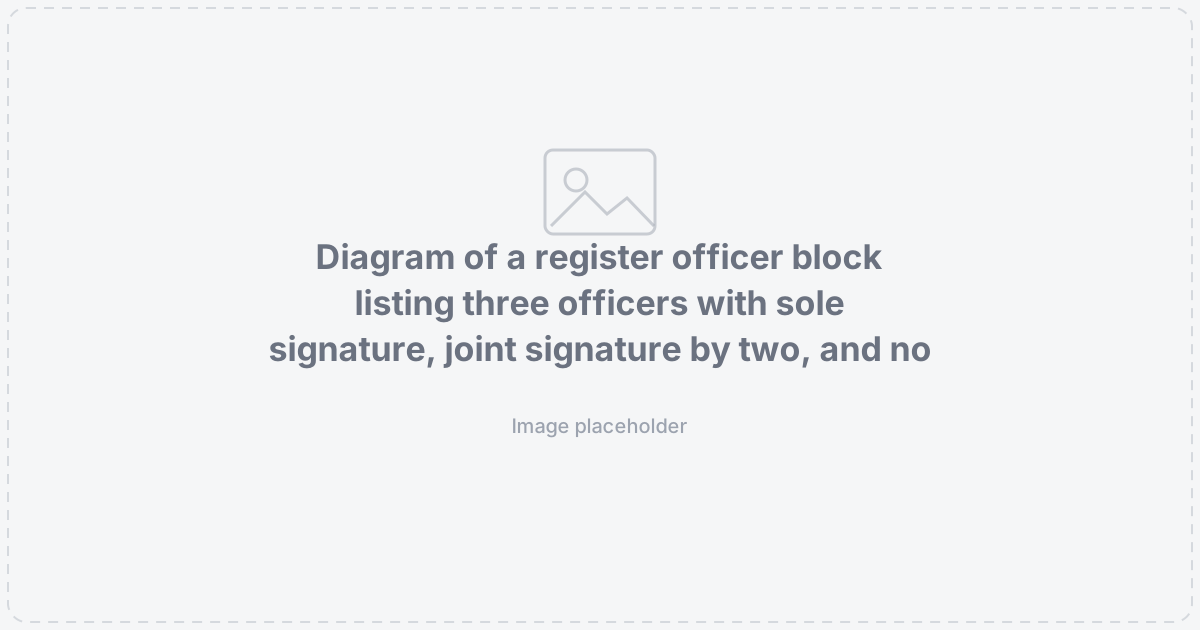
Every officer in the entry carries a form of signature: sole signature, joint signature by two, procuration, or explicitly no signing authority. That block describes who can commit the company. Take the name that will appear on your contract and find it there. If it is absent, or present with joint signature only, you need a second authorised signature or a written power of attorney — and discovering that after a dispute has started is expensive.
In both of the common capital forms, at least one person entitled to represent the company must be resident in Switzerland.
The register is also searchable by person, so you can read every other mandate a name holds alongside the company in front of you. A director who turns up with sole signature across a cluster of otherwise unrelated entities is doing something structural — running a group, or providing professional directorships — and the pattern of the mandates usually tells you which.
4. Read the publication history, not today's snapshot
An extract is a snapshot. The sequence behind it is the document.
Every entry, change and deletion in a cantonal commercial register passes through the Swiss Official Gazette of Commerce, so a company's history arrives as a list of dated publications you can read in order. How to read one of those notices goes through the fields that carry signal.
Two or three years is usually enough. What earns a second look: a domicile that has moved more than once in a short period; a board and an address changing in the same publication; a purpose clause rewritten; an audit firm removed; a capital reduction. None of these is a finding on its own. Each is a question worth asking before you sign.
5. Work out how much ownership is visible at all
This depends entirely on the legal form, and the answer catches people out.
A GmbH's quotaholders are entered in the register by name, with the nominal value of their quotas, so immediate ownership is public and every change of it is published. An AG's shareholders are not in the register at all — the company keeps its own share register, and that is not public. The differences between the two forms decide what evidence exists before you go looking for it.
Neither form puts ultimate beneficial owners on the public record. A non-listed company keeps a private list of the natural persons behind shareholders who cross the statutory reporting threshold, but that list sits with the company, not with the register. So no Swiss register search hands you a UBO, and anything that claims to be doing so is describing something else. What is recorded, and where sets out how to build a defensible view of control instead.
In a transaction, the working answer is a shareholder or UBO declaration from the counterparty; the register work tells you whether it is consistent with everything else that is visible.
6. Look at the entity in its network
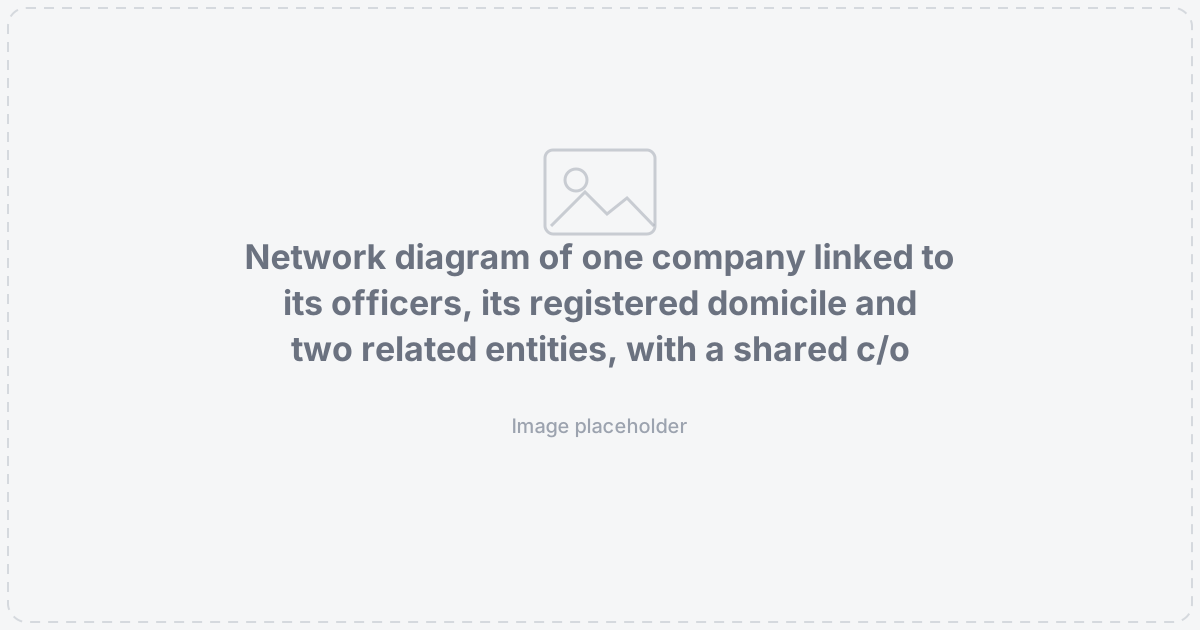
Officers, addresses and publications are far more legible as a graph than as a stack of extracts. Putting a company and everything registered around it on one canvas is how you notice that two counterparties share a director, or that a new supplier was incorporated last quarter by someone from a company you already declined.
Be strict about what that view means. Shared officers show a common person, not common ownership. A shared c/o domicile at a fiduciary shows a common administrator — entirely ordinary, and the most over-read signal in this work. What the graph holds is registered officers, signatories, domiciles and publication history. Control is inferred from it, and the inference should be labelled as one in whatever you write up.
7. Then go outside the register
The commercial register records legal facts and nothing beyond them. It does not certify that a company is solvent, competent or a reliable counterparty; the register office reviews filings for formal compliance rather than investigating the business behind them. A spotless register history and a bad payment record coexist comfortably.
So the last part of the check happens elsewhere: payment experience and a commercial credit file, debt-enforcement and bankruptcy notices, sanctions and PEP screening against the lists that apply to you, adverse media, and the company's own website read against the register entry rather than believed on its own terms. A professional-looking site proves that someone bought a domain.
8. Set the file to check itself
Verification has a shelf life. Status, officers, signature authority and domicile all change after you have finished, and the change is published whether or not anyone tells you. For counterparties that matter, put the entity on a watchlist so you can review its publications from one place instead of rediscovering them one at a time — a quarterly manual re-check is the kind of task that quietly stops happening.
The short version
- Match legal name, legal form, seat and UID to the contract, not to the letterhead.
- Confirm the status; if the entity is deleted, establish why.
- Find your signatory in the register, and check the form of signature covers what they are signing.
- Read the last few years of publications in order.
- Establish what ownership the legal form makes public, and get a declaration for the rest.
- Check the network, and keep inference labelled as inference.
- Do the credit, sanctions and media work outside the register.
- Diarise the re-check, or automate it.
In practice
The value of a checklist is that it is the same every time. Pull the entity, read the officers and their signature rights, read the publications in order, then go and find everything the register was never going to tell you. If it is faster to ask the questions in plain language, do that — and take every load-bearing answer back to the register entry it came from, because a summary is not a source.
Frequently asked questions
Is the UID the same thing as the CHE number, and is it also the VAT number?
The UID is the CHE number: CHE-xxx.xxx.xxx is simply how the federal business identification number is written, with CHE as the country prefix. The VAT number is that same identifier with a tax suffix appended — MWST in German, TVA in French, IVA in Italian. So a registered entity carries exactly one UID, and holding a UID does not by itself mean the company is registered for VAT. When you match a counterparty, match the digits and ignore the suffix.
Do I need a certified extract from the register office, or is an online lookup enough?
For your own file, the public register lookup is enough — it shows the same current entry a paper extract would. A certified extract from the cantonal commercial register office is what you need when somebody else has to rely on the document: a bank opening an account, a notary, the counterparty's lawyer, or a foreign authority, which may additionally require a legalisation such as an apostille. Order the certified version when the document has to travel; use the online entry for the check itself.
What if the person signing our contract is not in the register at all?
Read the whole officer block again first, including any entry marked as procuration — those are the easiest to skim past. If the name really is absent, the register cannot help you: ask for a written power of attorney granted by people who are registered and whose signature rights are sufficient together, or have one of those registered signatories countersign. "It is handled internally" is not something you can produce later, and an authority you cannot evidence is worth nothing on the day the deal goes wrong.
Can I check a Swiss company's creditworthiness in the commercial register?
No. The register records legal facts about the entity and nothing about how it pays. Insolvency does eventually surface — bankruptcy proceedings are published officially — but the absence of a bankruptcy notice is not evidence of solvency, and a company can be overdue on every invoice with a spotless register history. Creditworthiness comes from a commercial credit file, payment experience and a debt-enforcement register extract, all of which sit outside the commercial register.
We are dealing with the Swiss branch of a foreign company — who is our counterparty?
The foreign head office. A Swiss branch has its own entry and its own UID, and its registered representatives are real, but it is not a separate legal person: the contract binds the company abroad. The Swiss extract therefore tells you about the branch only. Identity, status, ownership and solvency all have to be checked in the head office's home jurisdiction, and the Swiss entry is the starting point rather than the answer.
Related articles
Active, merged or dissolved: Swiss company status
What 'active' really means on a Swiss register entry, how liquidation and mergers appear in the gazette, and why a deleted company is not always bad news.
10 min read
Read articleHow a Swiss company credit check works
What a Swiss commercial credit report is assembled from, why the register cannot tell you whether a company pays, and what a debt-enforcement extract adds.
11 min read
Read articleSwiss company research tools in 2026
Which source answers which question about a Swiss company: the register index, the UID, the gazette, cross-border aggregators, B2B directories and graph tools.
9 min read
Read article